- Jul 27
Why Won't My Legs Settle?
- Hassan Abdal
- neuromonitoring, Blogs, neuroscience, sleep
- 0 comments
You know the feeling, or at least you know someone who does. The end of a very long day! The lights have gone out, your body has relaxed, and the moment you are about to fall asleep, your legs start behaving weirdly, almost like they are revolting. Something itchy and almost burning begins crawling up from your calves - you change position, stretch, walk up and down the hallway for a while, and the sensations subside. However, as soon as you lay down to go back to sleep, they return.
This nighttime battle has a name - restless legs syndrome (RLS), also known as Willis–Ekbom disease (after the two physicians who described it, almost 3 centuries apart). It is much more common than one might think; up to 7-10% (and occasionally up to 15%) of adults experience it to some degree, and it is often misdiagnosed [1, 2]. The good news is that it is not a result of one’s nerves or lack of discipline: it is an actual neurological disease, and the reason for its occurrence is surprisingly tied not to the brain but to the spinal cord.
What Restless Legs Actually Feels Like
RLS belongs to a class of neurologic sensorimotor disorders; its defining characteristic is an unpleasant paresthesia accompanied by a sensation of needing to move the legs. Several criteria should be met for the diagnosis of RLS [1, 7]:
1. Uncomfortable sensations and the desire to move the legs, often described as “creeping,” “crawling,” “itching,” “burning,” “pulling,” or “aching”
2. The urge to move is stronger when at rest or when lying down
3. Movement temporarily relieves discomfort
4. These symptoms follow a circadian rhythm: they are usually weaker during the day but severely intensify in the evening or night
5. The pattern is not explained by another condition or by positional discomfort
RLS affects people of all ages and backgrounds but is more common in women and tends to develop with age. It is strongly linked with low iron levels, pregnancy, and kidney dysfunction [2, 7]. For most people, it is a minor nuisance, but for some it severely impacts quality of sleep and, consequently, mood and cognitive function.
Meet PLMS: The Nighttime Cousin
Symptoms of RLS occur when a person is awake, but many RLS sufferers also experience another phenomenon during sleep: periodic limb movements of sleep (PLMS). They manifest as intermittent movements of the legs during sleep, typically flexion of the big toe and ankle, and sometimes knee and hip as well, lasting for a short time and recurring every 20 to 40 seconds throughout the night in long episodes [6]. PLMS are remarkably like the plantar Babinski reflex (a common component of the neurological exam), with the Babinski sign being elicited by stroking the sole [8].
Between 60-80% of people with RLS also have PLMS, which can be objectively measured during an overnight polysomnography (PSG) test [6]. Even when they do not wake a person up, these movements can interrupt sleep, contributing to daytime sleepiness despite long hours of apparent rest. PLMS can also occur independently from RLS, as a separate diagnosis.
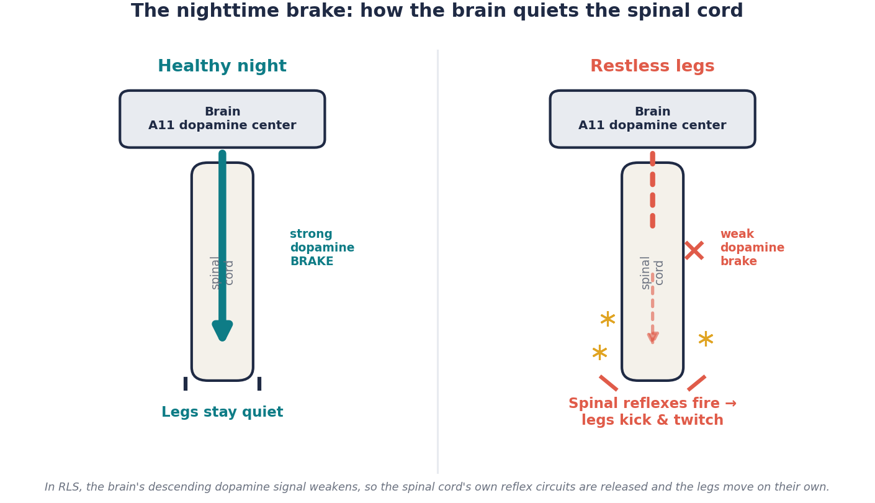
Figure 1. In a healthy night, the brain's descending dopamine signal keeps the spinal cord's reflexes in check. In RLS, that brake weakens and the cord's own circuits fire, moving the legs on their own.
The Spinal Cord Takes Center Stage
As mentioned earlier, the root cause of RLS is dysfunction of the central nervous system. The interesting twist is that it occurs predominantly at night, suggesting the involvement of specific mechanisms. The spinal cord reflexes are typically strongly inhibited by the descending dopaminergic projections from the brain, specifically from the A11 region [2, 3]. These neurons form the only dopamine pathway projecting to the spinal cord, and their role is to regulate spinal circuits controlling the plantar withdrawal reflex (a healthy response to painful stimuli). This inhibition is significantly reduced in RLS: studies on patients with RLS show that the spinal flexor reflex has a lower threshold for activation and broader receptive fields, with increased excitability that is especially prominent at night [4]. The periodic limb movements that characterize PLMS are remarkably like the Babinski reflex, which is another manifestation of disinhibited spinal cord activity tied surprisingly not to the brain, but to the spinal cord.
Spinal cord circuitry can act independently, and several mechanisms may contribute to RLS. First, the disinhibition of the spinal reflexes could be caused by malfunction of one of the brain regions responsible for descending inhibition. Moreover, people with RLS often have spinal cord injury or spinal cord lesions, and periodic limb movements can occur below the level of injury [5, 6]. Thus, the spinal cord itself can support the autonomous movements observed in RLS and PLMS.
Why Iron, Why Dopamine, and Why at Night
Why do the spinal cord reflexes, which are normally strongly suppressed, fail to be inhibited in RLS? Two mechanisms play a role here: dopamine and iron homeostasis. Iron is a critical element for the synthesis of dopamine, acting as a cofactor for tyrosine hydroxylase, the rate-limiting enzyme in dopamine production. In fact, many patients with RLS exhibit dysfunctional iron regulation specifically in the brain, despite normal blood iron levels. This leads to reduced dopamine signaling in the A11 region, disrupting the inhibition of the spinal reflexes. This is referred to as the “iron-dopamine hypothesis” of RLS [2, 3].
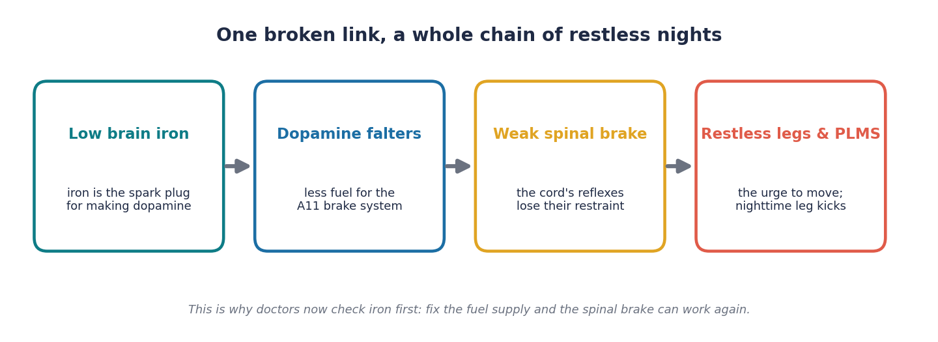
Figure 2. The chain of events in RLS: low brain iron limits dopamine production, which weakens the spinal "brake," which lets the cord's reflexes and the legs run loose.
Dopamine levels naturally follow the circadian rhythm, peaking in the morning and reaching their lowest point at night. The same applies to iron metabolism and its impact on dopamine production. This explains the evening onset and nocturnal predominance of RLS symptoms [2]. In combination with the reduced sensitivity of dopamine receptors, this results in the evening inability of dopamine to inhibit spinal reflexes, which causes the characteristic restless legs. Essentially, RLS is a dopamine-related neurological disease that occurs when the natural dopamine decrease at night coincides with reduced receptor sensitivity.
Could This Be You? A Quick Self-Check
You do not need to visit a sleep clinic to determine whether you have RLS. Three simple questions can give you an idea of whether you might have restless legs syndrome [1]:
Do you experience unpleasant sensations and the need to move your legs predominantly when at rest?
Do you find that your legs only feel better when you move?
Do these sensations occur more often in the evening or at night?
If you answered “yes” to these questions, and this pattern occurs often enough to disrupt your sleep, you may have RLS. Several common factors can increase the risk of RLS that you may want to mention if you decide to make an appointment with a neurologist or a sleep physician. Specifically, pregnancy and kidney disease are both strongly linked with the development of RLS. Low iron and anemia are also strongly linked to RLS, and the condition often runs in families; several genes, such as MEIS1 and BTBD9, raise a person's risk [10, 2, 7]. You will also probably be asked to list any medications you are currently taking, as several common antihistamines, antidepressants, and migraine medications can precipitate RLS. Finally, a simple blood test for ferritin can provide information about your iron levels: it is a relatively inexpensive procedure that most clinicians recommend and aligns with current standards of care for diagnosing RLS. The condition is frequently misdiagnosed as insomnia or anxiety, so naming this specific pattern can help to rule out other causes of restless nights.
What Actually Helps and a Recent U-Turn
The good news is that there is an effective treatment for RLS, and the standards of care have recently improved. The new treatment guidelines from the American Academy of Sleep Medicine, released in 2024, provide updated information on the diagnosis and management of RLS [9]. First and foremost, physicians recommend checking iron levels in all patients with RLS, particularly ferritin and transferrin saturation. Supplementation, both oral and intravenous, should be considered in cases of depleted reserves.
When medication is indicated, the first-line treatment now involves a class of drugs called alpha-2-delta ligands (gabapentin, gabapentin enacarbil, and pregabalin). They act by reducing the excitability of the hyperactive spinal circuits rather than directly affecting dopamine signaling. Dopamine agonists (pramipexole, ropinirole, and rotigotine), which used to be the default treatment for RLS, are no longer recommended due to their risk of causing augmentation effects over time. This means they can paradoxically make restless legs worse after months or years of use: prolonged use can exacerbate daytime symptoms, which then extend to nighttime ones. Moreover, the symptoms often spread to the upper limbs and appear earlier in the day.
Lifestyle modifications are also an important part of managing RLS. The standard advice includes maintaining a consistent sleep schedule, engaging in regular physical activity, and practicing daytime stretching to reduce discomfort and promote relaxation. Patients are also encouraged to avoid known RLS triggers when possible. Unfortunately, these are rather generic recommendations, and there is still no specific, individualized, drug-free treatment for RLS. However, the latest developments in RLS treatment suggest that the future may be bright for patients seeking alternatives to medication.
Recent advances in neuroscience demonstrate that neurophysiological mechanisms in the spinal cord can be effectively targeted to reduce symptoms of restless legs syndrome. The newest non-pharmacologic interventions involve direct electrical stimulation of peripheral nerves, particularly the peroneal nerve in the leg: high-frequency stimulation protocols have been shown to reduce discomfort and improve sleep in patients with RLS. For the most severe cases, spinal cord stimulation can also be considered [7, 9].
The Takeaway
If your legs stage an uprising every night, you are not alone: in fact, you are among the approximately 7-10% of the adult population who experience uncomfortable and inconvenient restless legs syndrome. The good news is that it is a neurologic disease with a reasonably well-understood cause, although it remains mysterious how exactly it develops. The RLS circuitry involves a reduction in the inhibitory tone from the brain to the spinal cord, which causes involuntary leg movements, particularly at night. Following this chain from the periphery to the center and back, one can see how scientists and clinicians address the disease: current treatment recommendations focus on restoring inhibited spinal reflexes and reducing excitability in the hyperactive circuits. This is achieved by supplementing iron (when deficient), reducing the impact of the various RLS triggers (such as caffeine), and prescribing medication that targets either the spinal cord or the dopaminergic system. Restless nights are common, but they are also treatable.
Disclaimer: This article is intended for educational and informational purposes only and should not be considered a substitute for professional medical advice, diagnosis, or treatment. Individuals who suspect they may have restless legs syndrome (RLS) or any other sleep-related disorder should consult a qualified neurologist or sleep medicine physician for a comprehensive evaluation and appropriate care.
About the Author:
Hassan Abdal is a senior neuroscience student in the School of Behavioral and Brain Sciences at The University of Texas at Dallas, Richardson, Texas. He authored this article as part of Professor Faisal R. Jahangiri's Sleep and Sleep Disorders course. Hassan is passionate about neuroscience and is committed to translating complex scientific concepts into engaging, accessible content for a broad audience.
References
[1] Allen RP, Picchietti DL, Garcia-Borreguero D, et al. Restless legs syndrome/Willis–Ekbom disease diagnostic criteria: updated International Restless Legs Syndrome Study Group (IRLSSG) consensus criteria. Sleep Medicine. 2014.
[2] Restless Legs Syndrome: From Pathophysiology to Clinical Diagnosis and Management. Frontiers in Aging Neuroscience. 2017. https://www.frontiersin.org/articles/10.3389/fnagi.2017.00171/full
[3] Dopamine and iron in the pathophysiology of restless legs syndrome (RLS). Sleep Medicine. 2004. https://www.sciencedirect.com/science/article/abs/pii/S1389945704000243
[4] Bara-Jimenez W, Aksu M, Graham B, Sato S, Hallett M. Periodic limb movements in sleep: state-dependent excitability of the spinal flexor reflex. Neurology. 2000;54(8):1609–1616.
[5] Restless Leg Syndrome/Willis–Ekbom Disease Pathophysiology. Sleep Medicine Clinics. https://pmc.ncbi.nlm.nih.gov/articles/PMC4559751/
[6] Drakatos P, et al. Periodic limb movements during sleep: a narrative review. Journal of Thoracic Disease. 2021. https://jtd.amegroups.org/article/view/58648/html
[7] Restless Leg Syndrome: Pathophysiology, Diagnostic Criteria, and Treatment. Pain Medicine (Oxford). 2022. https://academic.oup.com/painmedicine/article/23/5/1032/6353614
[8] Smith RC. Relationship of periodic movements in sleep (nocturnal myoclonus) and the Babinski sign. Sleep. 1985;8(3):239–243.
[9] Winkelman JW, Berkowski JA, DelRosso LM, et al. Treatment of restless legs syndrome and periodic limb movement disorder: an American Academy of Sleep Medicine clinical practice guideline. Journal of Clinical Sleep Medicine. 2024.
[10] Jahangiri FR. NSC 4320 — Sleep and Sleep Disorders, lecture content, The University of Texas at Dallas; and Dr. Jahangiri's Blog, https://globalinnervation.blogspot.com.